
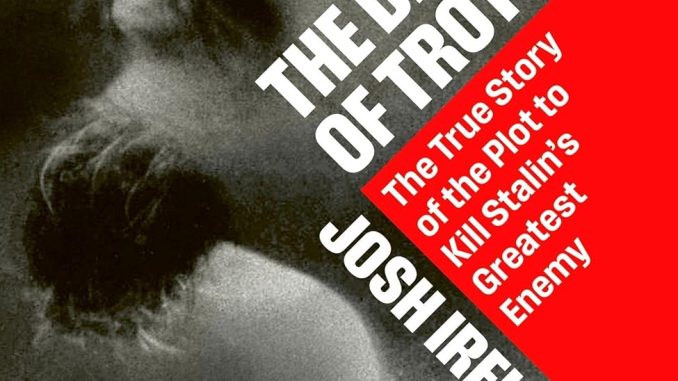
‘The death of Trotsky: The true story of the plot to kill Stalin’s greatest enemy’, by Josh Ireland deals with Stalin’s vilification and hunting down of his most formidable political opponent, Leon Trotsky, the co-leader of the Russian revolution, along with Lenin, and the main organiser of the Red Army against capitalist counter revolution.
Josh Ireland provides a narrative that blends high‑stakes espionage with psychological portraiture. The result, however, is deeply flawed. While Ireland writes with narrative verve, his book suffers from a superficial understanding of revolutionary politics, a personalisation of historical conflicts, and an omission of key political context.
Ireland’s sourcing is equally problematic. He cites Trotsky’s unfinished book, Stalin, and various published newspaper interviews with Trotsky, but neglects Trotsky’s major theoretical works, such as The Permanent Revolution, The History of the Russian Revolution, and The Revolution Betrayed, in favour of hostile biographers.
On occasions, Ireland is politically slanderous with his claims. Outrageously, the author alleges that during the early years of the young workers’ state in Russia, Trotsky shot his car driver for continually failing to turn up on time to bring Trotsky to appointments. There is no evidence cited for this absurd comment.
The book begins as a high‑stakes thriller set in the 1930s. Ireland details the defection of Ignazio Reiss, a prominent NKVD agent, to the Trotskyist movement (the NKVD was the Stalinist regime’s main security, police, and intelligence body from 1934 to 1946). Aware of the extreme peril, Reiss travelled to France to link up with Trotskyists, only to be tracked, lured to a meeting, and assassinated by machine‑gun fire from his former comrades.
The narrative shifts to 1905, chronicling the first meeting between Trotsky and Stalin at an RSDLP(Russian Social Democratic Labour Party) conference. Ireland compares the two figures. The treatment of Trotsky is superficial and sometimes hostile. He focuses on Trotsky’s perceived arrogance, “flamboyance,” and vanity. Trotsky is labelled a “strutting peacock.” Yet even Ireland is forced to concede Trotsky’s brilliant intellectual gifts, his natural leadership abilities, his oratorical skill, and his remarkably broad scientific, art and cultural interests (Ireland describes Trotsky as the foremost literary critic of his day in Russia).
Stalin, by contrast, is painted as a morose, scheming figure, who had nothing or very little to say during party meetings. He was insignificant during the 1905 and 1917 revolutions in Russia.
In the author’s account of the October Revolution, the overthrow of the Provisional Government is the toppling of a “reformist liberal‑minded government.” Ireland deploys the well worn hostile narrative that the October Revolution was a “coup of fanatics” led by a “fanatical, messianic party.”
This ignores the crucial historical context: that the capitalist Provisional Government, including reformist Mensheviks, continued a hugely unpopular war, ignored the working class and peasantry’s demands (perfectly encapsulated by Lenin with “land, peace and bread”) and found itself increasingly isolated. Ireland omits any mention let alone substantive discussion of the soviets (i.e. mass councils of elected workers, peasants and soldiers’ representatives) that represented a ‘dual power’ in society, and the rise of the Bolsheviks’ working class support over the year 1917, as the party led by Lenin, and which Trotsky joined on his return from exile, and in which he played a crucial role, skillfully put forward demands and slogans that chimed with the revolutionary masses’ desires. Ireland does acknowledge that Trotsky, on his return from exile was more politically decisive and daring than other Bolshevik leaders, like Stalin and Kamenev, who were cautious, confused, and conciliationist.
Civil war
More time is devoted to the civil war, where Trotsky is presented as “ruthless.” Ireland lays considerable opprobrium at Trotsky’s feet for his military methods during a civil war. This same “ruthlessness” is rarely applied by bourgeois historians to Abraham Lincoln, for example, who by necessity waged a ferocious war against the slaveholding Confederacy.
To his credit, Ireland does acknowledge Trotsky’s essential role in organising the Red Army, traversing Russia to the equivalent of five times over the earth’s surface in his ‘revolutionary train’. Trotsky boosted morale among Red Army soldiers along the front lines with rousing revolutionary speeches.
However, the book falsely implies that the Bolsheviks caused the civil war, ignoring the intervention of twenty‑one capitalist armies and the Russian White counter‑revolutionary forces. Ireland does not seem to have referenced Trotsky’s voluminous civil war writings. The Red Army eventually vanquished the Whites, largely due to the class appeal the young Soviet government made to workers and peasants throughout the former Czarist empire, while the Whites and foreign capitalist armies only offered more class oppression, terror, and exploitation.
Ireland’s analysis of the early Stalinisation of the Russian Communist Party and the state apparatus recycles the conventional bourgeois narrative that Trotsky was outmanoeuvred by Stalin and that Trotsky failed to cultivate a following in the party. History is reduced to a clash of personalities. Lenin’s last will and testament, where he castigated Stalin and insisted he should not be allowed to hold on to his position as general secretary, is mentioned by Ireland. Stalin turned Lenin’s views on their head, Ireland writes, admitting rudeness but that this was only against enemies of the revolution.
The analysis presented overlooks the profound impact of a series of revolutionary defeats that occurred in Europe throughout the 1920s and 1930s. The absence of substantive discussion regarding events such as the bloody setback of the Chinese Revolution (1927), the defeat of the British General Strike (1926), the failure of the German Revolutions (1918 and 1923) and eventual rise to power of Hitler, and the defeat of the Spanish Revolution (1936-1939), are major deficiencies. These defeats dramatically shifted the balance of class forces globally, intensified the isolation of the Russian Revolution, and contributed to the rise of Stalinist counter revolution.
This context is vital for understanding the eventual trajectory of the Soviet Union. As true internationalists, Marx, Engels, Lenin, and Trotsky, and all the great Marxist leaders, were unified in their belief that establishing a socialist society was fundamentally impossible within the confines of a single nation-state, especially one as economically underdeveloped and historically semi-feudal as Russia was prior to 1917. The entire revolutionary perspective of Lenin, Trotsky, and the Bolshevik leadership up to and during 1917, was anchored to the premise that the Russian Revolution, acting as a crucial spark, was merely the first stage of a world socialist revolution. They were convinced that the survival and development of the workers’ state and socialism in Russia were inextricably dependent upon the socialist revolution extending beyond its borders, particularly succeeding in the advanced capitalist countries of Western Europe, whose industrial and cultural resources were essential for a transition to genuine socialism and eventually world communism.
The failure of the international revolutionary movements to achieve victory in the 1920s and 1930s effectively paved the way for the bureaucratic degeneration of the young isolated workers’ state. The series of defeats of revolutionary movements in Europe fostered the growth of a conservative, privileged bureaucracy within the Soviet Union. The bureaucracy gradually centralised power, suppressing internal democracy and dissent, and workers’ control and management of the economy, and eventually sought a leader for their material interests, personified by Stalin.
Gravedigger of the revolution
Ireland relates how the conflict within the Russian communist party led to Trotsky denouncing Stalin as the “gravedigger of the revolution” at a politburo meeting. This was followed by a rigged party expulsion meeting where Trotsky was bayed at by a hostile crowd, with ink wells thrown at him as he tried to speak, including by former close comrades.
Ireland covers Trotsky’s forcible exile from Russia to Alma‑Ata, in Kazakhstan (January 1928 to February 1929). One arresting officer, a former Red Army comrade of Trotsky’s, dramatically offered to shoot Trotsky rather than deport him – an offer Trotsky rejected. Deported from the USSR in February 1929, Trotsky was sent to Turkey, settling on the island of Prinkipo in the Sea of Marmara. This was followed by France (1933 to 1935) and Norway (1935 to 1936), where left leaning governments were in power. However his movements and political work were severely restricted as social democratic governments in both countries bent to the pressure of the Stalinist Soviet Union. Eventually Trotsky was told he was no longer welcome in Norway, and had to flee to Mexico (1937 to 1940).
The author emphasises that during the crucial years of the early 1920s, Trotsky sporadically withdrew from decisive action in his struggle against Stalin and the rising bureaucracy, often with mysterious illnesses, thereby enabling Stalin’s manoeuvres and intrigue to succeed. Trotsky’s own argument was that the revolution’s international isolation and the economic backwardness of Russia were the main factors allowing Stalin, and the conservative bureaucracy he represented, to gradually take power. A significant omission by Ireland is any mention of the Left Opposition that Trotsky established as a means to have a struggle inside Russia, and later internationally, against the Stalinist degeneration, beyond fleeting comments about temporary collaboration with other Old Bolshevik leaders, like Zinoviev and Kamenev.
The Stalinist state repression against the Left opposition and Trotsky’s family and relatives began in earnest. Trotsky’s son Sergei, an engineer, who was not involved in politics, was arrested on absurd trumped up charges in March 1935 by the NKVD. Initially sentenced to a labour camp in Krasnoyarsk, Siberia, he was re-arrested during the height of the Great Purge in 1937 and faced absurd accusations including sabotage and participating in a supposed “Trotskyite poisoning plot”. He was shot on 29 October 1937, aged 29, after sentencing by the Military Collegium of the Supreme Court of the USSR.
Ireland’s treatment of Trotsky’s family extends to his daughters. He portrays Trotsky as emotionally distant from his daughter Zina, suggesting he was culpable for her psychological distress, having “abandoned” Zina and her mother, Aleksandra Sokolovskaya (1872–1938), – an early political mentor to the young Lev Bronstein (Trotsky) – when he fled Tsarist exile in Siberia in the early 1900s. Yet Ireland elsewhere notes that Trotsky’s first wife supported his escape to further the revolution. Later she was a supporter of the Left Opposition, before falling victim to Stalin’s bloody purges.
Zina’s psychological problems led Trotsky to advise her to seek treatment in Berlin. But her financial and security difficulties escalated. She eventually committed suicide, after the Stalinist regime had stripped Trotsky and his entire family of Soviet citizenship, leaving her without refuge or money. Trotsky publicly attributed his daughter’s death to Stalin’s orders in an open letter.
Moscow show trials
Trotsky’s other son, Lev (Leon) Lvovich Sedov, was his closest political collaborator throughout the 1930s. After his father’s expulsion from the Soviet Union, Lev voluntarily joined him in exile, working tirelessly as his father’s chief aide and assuming a leading role in the International Left Opposition. He managed the Bulletin of the Opposition, exposing the Moscow Show Trials, and devoting himself to the preparations for the founding of the Fourth International (the Fourth International (FI) was founded in 1938 after Trotsky concluded that the Third International (Comintern) had become politically bankrupt under Stalin’s leadership. The FI was intended to continue the tradition of proletarian internationalism and to defend the revolutionary programme of 1917 against the bureaucratic degeneration of the Soviet Union).
Trotsky’s isolation and the relentless persecution of his family meant that Lev operated under constant threat, hunted by Stalin’s secret police who declared him the number one target after his father. Although these intensely difficult circumstances led sometimes to strains in the father and son collaborative work, their political allegiance remained unbreakable; Lev refused to distance himself from his father’s revolutionary Marxist cause against crisis ridden capitalism, fascism and Stalinism.
In February 1938, at just thirty‑two years old, Lev Sedov entered a Paris clinic for what should have been a routine operation. He died under suspicious circumstances. Trotsky was convinced his son had been murdered by the Stalinist secret police.
With Lev removed, a NKVD spy, Mark Zborowski (who had infiltrated Sedov’s circle) took control of the Bulletin, ensuring that vital movement documents were passed directly to Stalin.
Eventually nearly all of Trotsky’s family and relatives and most of his close comrades were killed by the murderous Stalinist regime.
Ireland details Stalin’s secluded life within the Kremlin and his habits as a “chief bureaucrat”. The author depicts Stalin as “forever vigilant” and fearful of the “silent support” for Trotsky. Stalin deeply regretted allowing Trotsky to leave the Soviet Union and to bring with him documents that were used in Trotsky’s political fusillades against the tryant. Yet Ireland claims Stalin failed to see that Trotsky was exiled in the 1930s with “no social base and no serious programme.”
In truth, support for Trotsky and the Left Opposition was extensive, involving tens of thousands, at least, across Russia. If not, why then did the Stalinist regime go to such extreme measures to purge thousands of opposition supporters, many of whom were physically eliminated, or sent to camps.
Trotsky arrived in January 1937, invited by the Mexican government. Ireland’s account of Trotsky’s final exile in Coyoacán, a suburb of Mexico city at that time, is vivid but uneven. Trotsky’s relationships with Diego Rivera, the renowned muralist and former communist party member, and his wife, Frida Kahlo, also an outstanding artist, who had a brief relationship with Trotsky, is recounted with novelistic detail.
Trotsky and his wife, Natalia Sedova, resided in the Blue House, where Kahlo had grown up. The building was heavily policed but Trotsky was able to make some trips to the countryside where he collected cacti. He worked feverishly, producing articles for the Bulletin, while Stalinist agents were sent by Moscow to keep an eye on him.
During his time in Mexico, Trotsky defended himself to the Dewey Commission (full title: The Commission of Inquiry into the Charges Made Against Leon Trotsky in the Moscow Trials). This body was established in March 1937 by the American Committee for the Defence of Leon Trotsky, and was chaired by the philosopher John Dewey. The commission’s findings refuted the Moscow Purge Trials against the Old Bolsheviks and other oppositionists, real or imagined, by Stalin. The commission is dismissed by Ireland as merely a “Trotskyist front”, despite acknowledging that it received documentary evidence and testimony from over forty witnesses. In fact, the commission’s impact among sections of the world’s working class and intelligentsia was significant.
Ireland surmises that in his last years Trotsky was grappling with uncomfortable thoughts about the cause he had dedicated his life to. The working class perhaps was not the revolutionary class of change. After all, the working class had been unable to prevent Hitler, Mussolini or Franco from coming to power. Moreover, Ireland, asserts, Trotsky was forced to consider that a bureaucratic totalitarian regime like Stalin’s Russia might be a historically necessity.
The author concludes that Trotsky has not given up his Marxist ideas but without much explanation. He does not refer to Trotsky’s works, such as Revolution Betrayed, which explained the historical processes that led to the degeneration of the revolution and also the possibilities of political revolution that Trotsky confidently outlined could lead to the restoration of workers’ democracy. Nor does Ireland discuss Trotsky’s writings on fascism, where he analysed the deep capitalist crisis and ruination of the petit bourgeois, which acted as a basis of support for fascist ideas. The failure of mass workers’ parties, the communist parties and social democrats, to stop the rise of Hitler is not discussed. In a footnote, Ireland acknowledges that Trotsky had an astute analysis of fascism, but this is not drawn out.
NKVD’s relentless pursuit
The final section of the book details the NKVD’s relentless pursuit to eliminate Trotsky. Ireland highlights Stalin’s consuming paranoia, describing how the tyrant thought of Trotsky constantly. This fear, Ireland suggests, stemmed from the possibility that Trotsky’s influence on international communist movements could undermine Stalin in the event of a new world war. Yet Ireland simultaneously contends that Trotskyism was “weak and irrelevant”.
The first armed assault on Trotsky’s Mexican compound was led by the Stalinist muralist, David Alfaro Siqueiros. Siqueiros and other drunken assailants entered the house in May 1940, with the help of one of Trotsky’s guards, Robert Sheldon Harte. They shot indiscriminately into each room, including the bedroom where Trotsky and his wife and comrade, Natalia Sedova, were sheltering under the bed. Trotsky’s grandson was slightly injured in the attack. Sheldon Harte was apparently abducted and then murdered after the Stalinist gunmen concluded he was untrustworthy.
After this attempted killing, Trotsky’s guards reinforced the house with fortifications against a predicted second attack. Stalin was determined that the new attack would succeed, and it was agreed within the chain of command of the NKVD to use considerable funds and resources to support a lone attacker next time – someone who could ingratiate his way into the Trotsky household. After various candidates were considered, it was eventually decided that this would be Ramon Mercader. His mother, Caridad, was a hard-line Stalinist from an aristocratic background, who boasted of liquidating 20 Trotskyists in Spain during the civil war, as part of the Stalinist purges against the anti Stalinist left, which fatally undermined the struggle against Franco’s forces.
Mercader, using the false identity “Frank Jacson”, a Canadian, and posing as a sometime journalist, infiltrated Trotsky’s household through a romantic relationship with Sylvia Ageloff, a New York Trotskyist and secretary for Trotsky. Ireland describes Mercader’s psychological distress as the assassination approached and notes that Mercader, in his post‑arrest statement, said he carried out the killing when he did because he could have “allowed myself to be convinced by him [Trotsky]”.
On 20 August 1940, Mercader managed to get Trotsky alone with him in Trotsky’s study and struck the great revolutionary in the skull with a mountain pick. Trotsky fought back, and guards held Mercader until police arrived. Though fatally injured, Trotsky lingered for hours. His last defiant political words were: “I am sure of the victory of the Fourth International…Go forward!”
Ireland’s narrative lays bare the security weaknesses at Trotsky’s compound and the lowered vigilance before the assassination. Why was Mercader allowed to be alone in the room with Trotsky?
Aftermath of Trotsky’s death
Ramon Mercader was convicted by Mexican authorities to twenty years imprisonment. He never admitted that he had assassinated Trotsky on the orders of the NKVD. His Stalinist paymasters ensured his incarceration was comfortable. Upon his release, Mercader went to the Soviet Union, where he was awarded the rank of retired KGB colonel with the right to monthly pension. During the 1960s in Moscow, an eyewitness remembered coming across Mercader in a restricted access library with several books either by or about Trotsky on the table in front of him.
Apparently disenchanted with life in Moscow, Mercader was finally able to live in Havana. He died of lung cancer in 1978, aged 65, and was buried in Moscow.
Natalia Sedova, Trotsky’s widow, lived in Mexico for a few years before moving to Paris. The Mexican government eventually bought the house where Trotsky had lived and turned it into a museum.
Decades later, the former Soviet Union collapsed, brought down by its own contradictions; a planned economy suffocated by the dead hand of a dictatorial bureaucracy. With the collapse of the regimes, so came the discrediting of the apparent invincibility of the ideas once promoted by the Stalinist regime and its supporters internationally.
Trotsky’s ideas were vindicated. He had predicted that the Soviet Union would collapse either from political revolution, that is, the working class removing the bureaucracy and introducing, once again, workers’ management and control of a planned economy, or that the bureaucratic strangulation of the economy over time would open the way to capitalist restoration, which is precisely what took place in the late 1980s and early 1990s.
However, Stalinist ideology is still alive today in various forms within the workers’ movement. It is incumbent on Trotskyists and Marxists internationally to recount the crimes of Stalinism and explain the basis on which this tyranny arose, in the fight for genuine socialism.
Josh Ireland’s The Death of Trotsky is a frustrating and politically and historically flawed book. It is well‑written, occasionally gripping, and contains moments of genuine insight into the psychology of its characters. But by prioritising personality over politics and revolutionary theory, Ireland produces a narrative that is shallow, misleading and, at times, outright slanderous towards the great revolutionary. The reader finishes the book knowing little more about why the Russian Revolution took place and degenerated, what the Left Opposition actually stood for, or why Trotsky’s ideas continue to resonate nearly a century after his death.
For those wanting a serious political and historical account, they will need to look elsewhere, not least to Trotsky’s own works, and to the publications of the Committee for a Workers’ International (most recently, Leon Trotsky – A Revolutionary Whose Ideas Couldn’t Be Killed – Left Books).
‘The death of Trotsky: The true story of the plot to kill Stalin’s greatest enemy’, by Josh Ireland (John Murray, 2025)