
For a working class answer to the political crisis
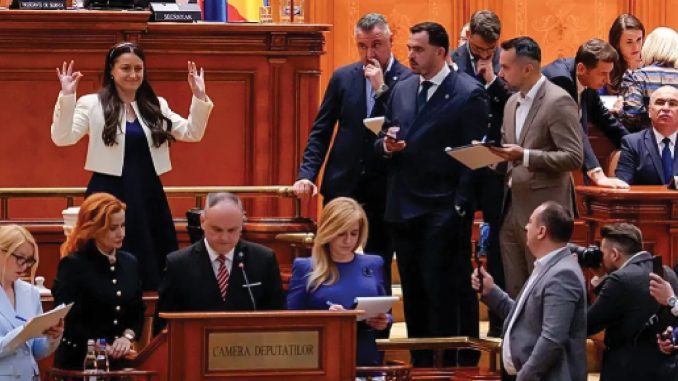
On 20 April, in a move dubbed “The Moment of Truth”, the so-called Social Democratic Party (PSD) announced its decision to withdraw political support for Prime Minister Ilie Bolojan and leave his coalition government. The PSD tabled a motion of no confidence in Bolojan which passed with the support of the right-populist AUR. Although the PSD had enthusiastically taken part in Bolojan’s government they decided to try to distance themselves from the governing coalition after a full year of supporting their austerity policies. Following the withdrawal of support for the coalition, it was clear that it would only be a matter of time before this government would fall.
Despite the many negotiations that have been made public, as well as speculation about possible configurations for a new government, it is clear that the internal stability of the capitalist regime is waning. At the same time, regardless of how many governments come and go before the next elections, we can expect constant attempts to continue Bolojan’s “reforms”—a wave of attacks on workers and young people unprecedented in recent years.
Only the independent action of the working class can halt or even reverse the wave of austerity. As workers in more and more sectors of the economy begin preparing to go on strike, it is important for socialists to combat any illusions in any of the capitalist camps—whether liberal or “sovereignist” (right-wing populist)—and to fight for a truly anti-system alternative.
The PSD and the “Moment of Truth”
The PSD’s withdrawal of political support followed Bolojan’s announcement that the government’s intention to privatize a number of state-owned companies and services. The list has since grown to include shares in CEC Bank, the Romanian Post Office, parts of the former Romanian Railways, Romgaz, etc. Although the PSD wants to give the impression that it saved state-owned companies from privatization by collapsing the governement, the reality is that the date of the “Moment of Truth” had been announced long before. Regardless of whether they knew about the privatisations plans in advance or not, the PSD left the government when the wave of neoliberal policies became too difficult to justify.
For the PSD, joining the government was a political sacrifice that the capitalist class imposed on all liberal and traditional parties. The fundamental aim of this coalition was to impose the austerity measures, spending cuts, and privatizations (euphemistically called “reforms”) demanded by the European Commission under the threat of losing funding. Starting with pupils, students, and health and education workers, the government continued to freeze hiring, cut wages, and raise the retirement age.
As always, the anger of the majority of workers under attack has continued to grow, and we expect a broader movement of resistance to austerity, based on strikes, to emerge sooner or later. The PSD is the party of “social partnership,” that is, of the idea that it is in the unions’ interest to form a common front with the bourgeoisie rather than oppose them, to force them to negotiate at least. Thus, they have sought as much as possible to avoid being associated with the austerity government and to present themselves as an alternative to it.
Although the PSD leader, Sorin Grindeanu, sought to demonstrate his strength by tabling the no-confidence motion that led to the government’s collapse, he continued to call for a virtually identical government, in a coalition with the PNL (National Liberal Party) and RMDSZ (Democratic Union of Hungarians in Transylvania), but without Bolojan as prime minister. Such a government reshuffle would bring no change for the working class, which can expect the same austerity measures, but implemented more slowly and less brutally, in order to avoid a strike wave.
Caught once again in the middle of the class conflict between workers and employers, bourgeois politicians are desperately trying to avoid a political crisis that has already arrived. While the PSD has skilfully lied to the working class out of fear of the masses, the liberals are more candid in their attacks on us.
Socialists believe that wages and the healthcare and education systems should care for the sick and educate the young. The bourgeois parties, on the other hand, want to impose market logic on these sectors, intentions hidden behind talk of “efficiency.” Because the PSD does not want to carry out these cuts as quickly as the liberals would like, for fear of causing even greater crises in the system, they are demonized and portrayed as ‘the root of all evil’.
For these reasons, the government finally collapsed, and the PNL and USR (Union for the Salvation of Romania – neoliberals) have promised not to rebuild the coalition with the PSD. All parties are trying to distance themselves from governing, seeking to re-build support from opposition. This truly reflects how deep the crisis of capitalism goes.
“The Sovereigntist Opposition”
After the right-populist AUR (Alliance for the Unification of Romanians) party entered parliament in second place in the last elections, with 90 seats, the governing coalition used this to justify its existence, capitalizing on the legitimate fears of some young people and workers regarding an ultra-nationalist government modelled after the Trump administration in the US. But knowing the real goal of this government—to make the working class pay for the crisis of Romanian and international capitalism—it is only a matter of time before the right-wing populists would be accepted as loyal representatives of the bosses.
Although the liberal media has gone to great lengths in recent weeks to portray the relationship between the PSD and AUR as very close as the likelihood of them voting together on the ‘no confidence’ motion crystalised—even speculating that they might end up forming a new coalition—the reality is quite different. According to several sources within AUR, all traditional and liberal parties, with the exception of the RMDSZ (UDMR), have held negotiations with them. AUR MEP Adrian Axinia revealed that “There have been unofficial discussions with all parties,” and that they have “struggled” to counter the labels that have been thrown at the party for over a year in the public sphere.
George Simion said that the party he leads will support any motion of no confidence against the current government. However, the PSD, which initiated the motion, would not have had enough votes on its own, even with the AUR. Thus, it is possible that Simion asked that the motion is signed jointly, with the promise that they will convince the right-wing populist “opposition” to provide the final votes. These relatively small parties—SOS Romania, POT (Party of Young People), PACE , and a few independents—took advantage of the opportunity to boost their image and rise in the polls. This diverse group of right-wing populists and opportunists was unable to vote as a bloc, with the majority of those remaining in POT, for example, choosing not to support the motion and instead calling for a PSD-AUR- smaller right-wing populists government.
“The System” and collaboration with AUR
Following the announcement of the PSD-AUR no-confidence motion, the liberal media continued its longstanding campaign to demonize the PSD from an ‘anti-communist’ perspective, aimed at mobilizing the few supporters of austerity and privatization against even the slightest hesitation regarding these policies. This time, accusations of “collaboration with extremists” were hurled.
PSD MP Valeria Stoiciu announced her resignation, claiming that the PSD had betrayed European social democracy through this motion. Although it is true that European social democratic parties have not collaborated directly with right-wing populists, they have instead adopted their political positions, as in the case of immigration policies.
Any criticism from the Liberals, however, is hypocritical, as they have been just as willing to work with AUR on other occasions, such as the 2021 USR-AUR motion against the Cîțu government. Associations between PSD and AUR are based on the fact that many who voted for the PSD out of fear of the austerity measures imposed by the liberals have lost confidence in the “social democrats” and are prepared to vote for AUR in the hope of getting rid of the liberals.
In this way, both the PSD and AUR are false alternatives for the working class, attempting to present themselves as “saviours” while trying to derail the labour movement in the name of the same bosses.
AUR itself is courting the Liberals rather than the PSD, announcing that it will enter the government only with those who want to reduce the number of seats in parliament and funding for political parties—proposals that PNL and USR have used for years to pretend to be on the side of the people. These measures will disadvantage the RMDSZ (UDMR), AUR’s main goal, as well as extra-parliamentary parties.
The same government, now interim/acting
AUR Vice-President Dan Dungaciu recently stated that his party does not want to join the government, recognizing that they would not be able to govern without a majority or a stable coalition. Despite Sorin Grindeanu’s personal ambitions, the majority within the PSD, which has just left government, wishes to remain in opposition. Bolojan himself stated the day before the vote that he is “preparing the PNL for opposition.”
These developments reflect a deep political crisis within Romania’s capitalist regime. Without the possibility of forming a stable governing majority, the coming period could be marked by short-lived governments, lasting only a few months. Any other possibility, such as a “technocrat” prime minister or an interim government until the next elections, will be just as unstable and difficult.
In the absence of a solution from the Parliament, the bourgeois regime is waiting for the president to come up with one. Nicușor Dan, however, seems intent on avoiding any confrontation between the various Liberal factions, limiting himself to promising to block any right-wing populist government. Besides the fact that it will be impossible for him to do this without deepening the political crisis even further and disillusioning the masses—things Dan wants to avoid—his current solution seems to be stalling for time.
Since the vote on May 5, when the government was officially dismissed, it has been operating on an interim basis, now without the PSD. The new coalition, even more liberal than before, will use this opportunity to accelerate the “reforms” promised to the bourgeoisie.
The intention to move toward the privatization of several state-owned companies is very clear, but more than that, they are preparing a new wage law that continues the destruction of the education system and public services in general.
The new pay law seeks to “free” the pay system from any legislation that tied education salaries to the average gross wage across the economy. Furthermore, the proposed amount for entry-level teachers remains below the decisions and promises made following the 2023 strike. Thus, although the PNL-USR is attempting to distort reality by presenting the law as a balancing act between “excessively high” and low salaries, in reality, cuts are being made across the board to ensure everyone is equally impoverished.
Although the interim government’s days are numbered, Nicușor and the liberals will try to stretch the PNL-USR-RMDSZ (UDMR) coalition to the very end. Although they cannot, at least in theory, initiate emergency ordinances or draft laws, the fact that the liberals are in government puts their bloc in the parliament in a stronger position.
As for the RMDSZ (UDMR), they feel like children caught in a divorce. Being in a weaker position than the Romanian bourgeoisie, the representatives of Hungarian-speaking bosses in Székelyföld want to avoid an AUR government more than any other party. Most likely in waiting for a coalition to join, the RMDSZ is facing internal problems, with increasing talk of forming other opposition parties following the defeat of their former allies in Hungary, Viktor Orbán’s FIDESZ party. The success of new groups is far from guaranteed, as the new Hungarian TISZA government has indicated support for the RMDSZ. Nevertheless, dissatisfaction with the current system is palpable, and just as in Romania, Székelyföld could be shaken by the same wave of strikes, demanding the downfall of the RMDSZ, Bucharest’s representatives in the region.
Meanwhile, the PNL and USR have formalized their collaboration through a pact to support austerity measures and stand up to the PSD in parliament. Nevertheless, if the PSD decides to tolerate (not block) a minority government in this configuration, the Bolojan wing of the bourgeoisie will be able to continue its attacks on the masses for a while longer. This wing will, however, suffer a massive blow to its popularity if it insists on pursuing the same line during a strike wave.
What’s next?
One thing is clear: whoever is at the helm of the government will not willingly repeal the anti-worker legislation imposed by the Bolojan administration, but will instead seek to continue down the same path—albeit with a different narrative—aimed at avoiding a wave of strikes against austerity measures.
At the moment of writing, the PSD and RMDSZ are engaged in talks, hinting at the possibility of forming a minority government, while the liberals announced they want to block any government that wouldn’t cave in to their pressures to push for austerity. Such a government would do little more than accelerate the fall in popularity for all of the traditional bourgeois parties involved.
Although it is possible that AUR will come to power in the coming years, they will not bring about fundamental changes to the Romanian capitalist system; in fact, they aim to save it, deceiving a portion of the working class by placing the blame on scapegoats and diverting attention from the root cause of the problem. Both EU and Romanian capital are after the same thing: the continued exploitation of the working class. These days, they no longer even try to buy the working class’s silence with concessions, like decent benefits and public services; instead, they seek to cut them in order to save their dwindling profits.
None of the current parties have the interests of the majority in mind, and any new party that operates according to market logic will follow the same path. We need an alternative!
As Romania enters a period of political instability, it is important to build a labour movement capable of advancing the interests of the majority. The strikes scheduled for the end of this month will demonstrate the power of the working masses, who are ready to mobilize and fight in the workplace for positive political change.
The 2023 strike showed that the victory or failure of a strike is decided within the unions. That is why fleeing the unions is not a solution; we must reclaim and build them to organize the struggle for higher wages at the workplace, or against any rotten aspect of the system that workers want to fight against! The working-class majority cannot afford a perpetual political crisis; the unions must take on an active role during this period to ensure that everyone’s needs are met in the economic crisis that will be triggered by Trump’s war in the Middle East.
We need the unions to overcome the weaknesses of recent decades—such as the “social partnership” policy—so that they can organize the working class to play an active role in the political struggles ahead, in order to secure housing, jobs, and a decent standard of living for all wage earners. Strikes will demonstrate the power of the working class and how the entire economy depends on the working class to function! We need politics to reflect this!