
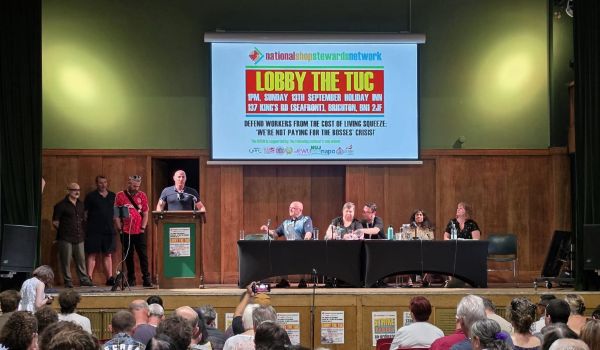
The 20th National Shop Stewards Network (NSSN) conference took place in London last Saturday. In the centenary year of the British 1926 General Strike, just days after Keir Starmer’s resignation as Labour prime minister, and after a week of stifling heat, over 200 trade union delegates assembled in London to discuss “We won’t pay for the bosses’ crisis!” and how the fightback can be organised. Socialist Party (CWI England & Wales) Executive Committee member Chris Thomas reports.
In opening the conference, NSSN chair Rob Williams outlined the key battles that the NSSN has been involved in over the last 20 years: “Where there has been strike action, where there have been workers victimised, where unions have been under attack by Tory and Labour governments and councils of all party colours – the NSSN has always been there and always will be.”
The NSSN is now on its ninth prime minister, and the seventh in a decade: “The lesson is that whatever party rosette you wear, if you stand for the system that puts profit before workers, their families and communities, and if you carry out their austerity, you will be in crisis.”
“Starmer has been booted out of office because his Labour government has barely changed a thing. The cost-of-living crisis is bearing down, we are still waiting for the inflation-proof pay rises we need to keep our heads above water and for the 50% strike ballot threshold to be scrapped.”
This is the situation that the new Labour prime minister, likely to be Andy Burnham, will walk into: “The union movement has a decision to make. Some want to wait for Andy to be crowned and then to decide what he wants to stand for. But in this period, in this crisis, we can’t wait for anyone because waiting creates a vacuum which Farage and the far right are trying to fill with divisive poison.” “How can you face up to the massive pressure coming from the bosses who want us to pay for their crisis, unless we mobilise the mass of the trade movement in united coordinated strike action?” “The unions must put a choice to him – it’s us, the working class, or the capitalists”.
- Conference unanimously voted for an action programme of demands to fight the cost-of-living crisis, to take into every workplace, union branch and trades council and onto every picket line. See socialistparty.org.uk
Steve Wright, FBU general secretary, said that firefighters will not be just waiting and sitting idly by while there is a coronation of Andy Burnham. The number one issue firefighters are facing right now is cuts to the front line. The FBU will be getting on the front foot, demanding that firefighters are not sacked, and fire stations are not closed. Burnham needs to be bold on the economic front including introducing a wealth tax and making sure that the likes of gas, water and energy are taken back into public ownership.
Sarah Woolley, general secretary of the BFAWU bakers’ union said it was disgraceful that in one of the richest countries in the world, 100 years after the General Strike, workers are still fighting for the right of working-class people to live decent lives. Food poverty is not a food problem but an income problem, a power problem. And the answer cannot simply be more food banks. It means rebuilding the power of working people because every advance that we have won has been fought for.
Angela Montgomery, assistant general secretary of the Prison Officers’ Association (POA), explained that it has been 32 years since the Criminal Justice and Public Order Act banned the union from striking and they are still battling to get back the right to strike.
Rhys Harmer, president of the London Transport Regional Council of the RMT, was pleased to see the NSSN, which the ‘late, great RMT general secretary Bob Crow’ helped set up, flourishing so much. He spoke about the union’s campaign against outsourcing: “With Keir Starmer on the way out and a new prime minister likely to be Andy Burnham on the way in, we cannot allow an inch of space for Andy Burnham to not make the right decision.”
Vice president of the PCS, Dave Semple, spoke about the battle that the new left leadership of the union is waging to ensure that conference policy is carried out and a national ballot for strike action is called in September, despite obstacles placed in their way from the union’s general secretary. PCS conference voted to ballot knowing that strike ballots were also likely in local government and in schools. “We have to build that fight across the entirety of the trade union movement and that battle has to start now.”
“But if we are going to take that united strike action, if we are going to put maximum pressure on this weak government, if we are potentially going to sweep this government out of the way, then we need to have something to put in its place. And that is why the debate has to be had across the trade union movement for a political alternative, for a new workers’ party that brings together the trade unions and those people desperate for change.”
Uniting the struggles
One of the themes running through the conference was the need to unite the strikes, to not leave individual workplaces to fight on their own, and to coordinate struggle within and between unions.
Schools
Conference received a message of support from Zoe Franklin, a Unison shop steward, on behalf of striking teaching assistants at Richard Cobden School in Camden – striking for pay. Over the last 16 years, in real terms, pay has been cut by 25%. “We are sick and tired of being underpaid and undervalued.” “Goodwill does not pay my bills”. “We now have Primrose Hill School joining us with their own strike and picket lines. More schools are in the process of joining the fight.”
Sean McCauley, a branch secretary in the National Education Union (NEU), asked why, if Labour had pledged to increase teacher numbers, there have been more rounds of redundancy and school closures than ever before. The NEU has seen a huge increase in local disputes, to record levels. The leadership calls this ‘lighting fires’ but it is more like fighting fires. “The vast majority of these disputes relate to issues that are at root national – job cuts, workload, privatisation and underfunding”. Under pressure from below, indicative ballots for national action were successful, and support staff turnout outstripped that of teachers. “We need maximum unity between the trade unions… we have a duty to exert pressure on our leadership to resolve any differences so we can work together to organise the unorganised and fight together to win for all education workers.”
Higher education
Christina Payne, University and College Union (UCU) National Executive Committee member, spoke about the strike at London Metropolitan University, where she is branch chair. Lecturers have taken 16 days of strike action and are now in the middle of a marking and assessment boycott against the threat of 120 redundancies – a fifth of the staff. The strikers have had excellent support from the students who face the scrapping of support services. Christina pointed out that university staff are facing redundancies all over the country. 24 universities are at risk of closure: “So what we need is a national UK-wide dispute in UCU”. “We’re having problems getting our national leadership to do that… so we need to force them.”
Further education
Scott Hunter explained how Socialist Party members are battling in UCU to get national action over pay and funding, despite attempts by the union leadership to delay it. “As myself and other people on the left argued [at national conference], if we delay till 2027, there won’t be a further education sector”. “We all know that the government is incredibly weak. It’s not going to get any stronger, despite the hopes of some in Burnham. And now is the time to push.” “Hopefully we can join the teachers and the university workers in a full-on education-wide sector battle, which is what is needed”.
Health
A message of support was received from union reps at the Unite strike at Cwm Taf Morgannwg University Health Board. There was also a Unite delegation at the conference from Barts NHS trust.
Sally Griffiths, assistant branch secretary of a Unison health branch spoke about the three different groups of health workers who have balloted for strike action. “It seems to our branch that health workers have reached their tipping point. They are ready to be organised, they are recognising their power”. “But starting little fires everywhere is not the way. Had the 50% threshold been removed as Labour had promised, we could’ve dealt with it all at once.” “We need a national industrial strategy, not just for Unison, but across all the health unions. We need a ballot on pay. There is a huge opportunity for a national fightback.” “We are reporting all the same issues. Job cuts, pay cuts, privatisation. So we need the TUC to call a national demonstration for jobs, homes and services for all against austerity and for workers’ unity.”
Bin workers
A delegation of striking Birmingham bin workers received a standing ovation from the conference. “It’s 18 months now we’ve been out on strike”, said convenor Matt Reid. “The determination from our members has been amazing and the support we have received from our trade union, our general secretary Sharon Graham and everyone else within the movement has been absolutely fantastic.”
“Now the Labour Party is destroyed completely in Birmingham. They had 65 seats out of 101, now they’ve got 15.” “We’ve got a coalition in place, of Lib Dems, Greens and Independents, who were very supportive before, but it’s all words until we see action from them.”
Onay Kasab, national lead officer for Unite, added: “To the Greens, we say this. If you claim to be the party of workers, then now is the time to stand forward and show that”. “You are now in charge. It’s not officers that tell you what to do. You’re the elected politicians. You instruct the officers to get the deal done. That’s how it works”.
In his opening speech Rob Williams had sent a message to Andy Burnham: “If you want to show workers you’re on their side, just go up the M40 to Birmingham… reinstate the terms and conditions and pay of the Birmingham bin workers. Give them back the £8,000 a year that’s been robbed of them.”
Fighting racism and the far right
Padraig Mulholland, deputy general secretary of NIPSA – the largest union in Northern Ireland – brought fraternal greetings to the conference. He spoke about the fantastic community and trade union response to far-right attacks that had resulted in people being burned out of their homes. Tens of thousands of workers and anti-racists came into the centre of Belfast, and the trade unions were front and centre of the anti-far right protests. But he warned that the danger has not gone away. What is needed is an anti-sectarian, cross-community resistance network that can implement disciplined self-defence of communities under attack and fight for decent homes, jobs, public services and living standards for all, “because we recognise the poverty and degradation in communities is the ground that the far right are using to build their forces”. The trade unions should be ready to call for a general stoppage of every single workplace if necessary. NIPSA will continue to play its part in building the anti-racist, anti-far right struggle.
Seema Saeeda from the Joint Council for the Welfare of Immigrants addressed the conference: “I know that every one of you represented here today … has the power together to defeat the far right”. “I don’t see a weak trade union movement but people prepared to stand up for migrant workers, to stand up against racism and to defeat the billionaire class and capitalism.”
Nationalisation
A London bus driver told conference about the successful four days of industrial action that bus workers at the Lea Interchange garage took against the victimisation of union reps. Union membership went up from 60% to 98%. But this is quite typical behaviour on London buses because of privatisation and unscrupulous employers who are also negligent on health and safety: “We need to renationalise so we don’t have this situation.”
Jason Wyatt, branch secretary for the Unite staff branch in Tata Steel in Port Talbot, described the crisis in the steel industry “always teetering on the edge of disaster, like a house of cards ready to come crashing down”. “We’ve had enough of warm words and we’ve had enough of empty promises… we need nationalisation in steel. Only this will safeguard our jobs, ensure investment and rebuild capacity in our industry.”
International solidarity
Conference began with a message of support from Turkish trade unionist Mehmet Türkmen who was jailed for speaking out about serious workplace health and safety abuses resulting in workers’ deaths and loss of limbs. Mehmet was recently acquitted at trial.
Contributions were made on important issues such as fighting disability cuts, sexual harassment, for trans rights and more.
National Shop Stewards Network conference debates the fightback in local government after May
The conference of the National Shop Stewards Network (NSSN) on 27 June invited various organisations that had stood candidates in May’s elections to send representatives to discuss the fightback in local government now. The invitation was accepted by Hugo Pierre from the Trade Unionist and Socialist Coalition (TUSC) and Ed Poole on behalf of Greens Organise, a grouping within the Green Party. Adam Harmsworth reports.
Hugo explained that the Green Party has just won hundreds of local council seats and leads councils – largely an anti-austerity vote. What will they do now they have more political power? Hugo highlighted the socialist-led Liverpool City Council in the 1980s, when a small group of Militant-supporting Labour councillors (the forerunner of the Socialist Party) built a fight with the District Labour Party and the trade unions in the city to mobilise a mass movement to resist cuts and win funding from the Tory government.
Ed said that the Greens’ “nice policies” are not enough. Greens Organise had asked all Green candidates to sign a pledge “to hold an emergency national summit with councillors, MPs, community organisations and trade unions to build a cross-party mass campaign to restore local government funding”. That pledge included “ending bad contracts” and “looking at the use of reserves and borrowing powers”. It was signed by over a 1,000 candidates, and about 250 were elected.
A striking Haringey teacher reported that before the May elections, the Greens’ leader had pledged to make helping to resolve the dispute one of his first acts. “Within days, the newly elected Green council wrote a letter explaining why, sadly, that would not be possible”. “This isn’t an academic discussion. If this dispute is not resolved in the next three weeks, some staff will have lost their jobs.” “To defend public services, we need needs budgets, and we need a working-class movement.”
No-cuts budgets?
The Greens Organise summit will be hosted by Hackney’s new Green council, and Ed said that trade unions will be involved. President of Hackney TUC, Brian Debus, asked Ed: “The summit document says the full restoration of local government funding should be a national priority. But would you support the demand for no-cuts budgets, in line with the service group policies of Unison, Unite and the GMB in local government?”
Tom Baldwin from Bristol reported how the Green council has passed £80 million of cuts over the last two years, and been proud of it! However he explained that in recent months, the Greens have begun meeting with Bristol Trades Council over the demand for a people’s budget, involving unions and residents. “That’s positive. But are they going to take that to its logical conclusion and write a budget based on what the city needs? That requires a struggle against the Westminster government.”
Tom also asked Ed: “What are the mechanisms within the Green Party to allow members to enforce upon the representatives of the party that they stick to an anti-austerity agenda? It’s a decentralised party, different branches have different rules. So you can get in on a radical-sounding platform but without a mechanism for any democratic control. Compare that to 1980s Liverpool City Council – the policies were decided by the District Labour Party, a huge body made up of delegates from Labour Party branches and the local trade union movement, representing tens of thousands of workers in the city – a real workers’ parliament, where the class itself had collective control of the council.”
Linda Taaffe, formerly secretary of the NSSN, welcomed the discussion. The Greens are now grappling with what they actually do in power, Linda explained, “that is class struggle!” The Greens have to decide which side they’re on “otherwise you’ll get hammered, and you’ll disappoint a lot of people who’ve joined your party”. “If you want us to help you, we will” she said, but if the Greens decide not to fight on the side of the working class, “we will oppose you with as much vehemence as we will support you if you’re with us”.