
Scottish Parliament, Welsh Assembly and English local election analysis
2026 will be remembered as the year that Britain’s existing political order finally fell apart. The two main parties that have governed Britain in the interests of the capitalist elite for the best part of a century – the Labour Party and the Conservative Party (the Tories) – and presided over endless attacks on the living and working conditions of the working-class, were mercilessly beaten by voters. Seeing what was coming down the track Labour politicians were warned by head office not to cry in front of the media. No wonder. In Wales – Labour’s traditional heartland – they were destroyed, left with just nine seats in a 96-member parliament. In Scotland more pro-independence MSPs were elected than ever before, while the 17 seats won by Labour was the lowest since the Scottish Parliament was founded in 1999. In England Labour lost almost 1500 seats in the English council elections, around 60% of all those they were defending. But while the Labour government was the main focus of voters’ fury, the pattern of the past – when the pendulum swung from red to blue and back again – has now been smashed. The Tories, already with only a fairly puny council 1300 seats, still managed to lose nearly 600 of them.
The desire to use the election to express anger at the establishment’s politicians was common to virtually every working-class voter. The electoral weapons that were picked up to achieve that varied enormously both between and within communities, however. It is probable that the sheer number of candidates were the biggest ever, reflecting the splintered political landscape. Many winning candidates therefore had relatively small shares of the vote. Nonetheless, overall, the biggest gainers were the right-wing populists of Reform, who won around 30% of the council seats contested. Reform won control of fourteen councils, including traditionally Labour working-class areas like Barnsley, Gateshead and Sandwell. In Wales it came second with 34 seats. In Scotland too it won 16% of the vote, giving it 17 seats from the regional lists section.
It could not be clearer that Farage, the founder and leader of Reform, is cynically harnessing all the reactionary ideas – particularly anti-migrant moods – that have been whipped up by successive governments, not least Starmer’s Labour. The danger of growing racism and division in the working class is clearly increased by Reform’s gains. Seeing this, many working-class voters were motivated to support whoever they thought could most effectively block Reform.
In desperation Labour used this to try and shore up its vote, putting out leaflets saying ‘voting Labour is the only way to stop Reform’ even in seats where it was clear that Reform would get only a handful of votes. Maybe that had some limited effect in preventing Labour suffering an even worst catastrophe. For most people, however, the Gorton and Denton parliamentary by-election two months ago, won by the Greens with Reform second and Labour pushed into third place, shattered the lie that voting Labour through gritted teeth was necessary to block Reform. In these elections the Greens won over 500 councillors, an increase of 400+ since these seats were last contested, and control of five councils – including Hackney, Lambeth and Waltham Forest in London. In addition, Aspire increased its majority in the London Borough of Tower Hamlets, and in neighbouring Newham the Newham independents combined with the Greens have a majority of councillors. There were also various anti-war and anti-austerity councillors elected in different parts of the country.
Unfortunately, however, many national trade union leaders will ignore the reality that was writ large in these elections, and keep using the threat of Reform to try to justify clinging to Labour. By doing so they are rolling out the red carpet for Reform. The primary reason working-class people voted Reform was in order to protest against a Labour government that has continued with Tory austerity. Initial surveys suggest that, on average, Reform’s vote went up most in the most deprived parts of Britain.
Role of the trade unions
The trade unions are the force in British society able to build a political party that fights for all sections of the working-class, and would be capable of cutting across Reform just as, in the 2017 general election, under Jeremy Corbyn’s leadership, Labour’s anti-austerity programme won a million voters who’d previously backed Reform’s predecessor UKIP. It is criminal for trade union leaders to instead continue to plead for Labour: a party that the working class has abandoned for good reason – because they understand it defends the interests of the elites rather than the majority.
True, in the wake of these election results even the most right-wing trade union leaders have had to echo some of their members’ anger with Labour. More militant leaders have done so more trenchantly. Unite general secretary Sharon Graham responded to the election results by saying that if Labour “does not shift decisively towards the working class it is finished. It is change or die. Now or never.” Similarly, Andrea Egan the new left general secretary of the public sector union Unison, called on Labour to change its “entire approach” and put “the interests of workers before the wealthy”. Yet Starmer’s Labour left the ‘last chance saloon’ long ago, the time has passed for pleading with Labour to change, an alternative needs to be built.
The money given by affiliated trade unions to Labour does not result in any power to influence the government via the structures of the Labour Party, as was shown when several – including Unison – tried in vain to get Andy Burnham agreed as the candidate to the Denton and Gorton by-election. The Birmingham bin workers have had to strike for over a year against a Labour council which carried out fire and rehire, backed by the Labour government. There was no mechanism within the Labour Party for Unite to change the councils disgusting behaviour. That is why, to mark the strike lasting a year, the Unite executive in March voted to cut its Labour affiliation fee by £580,000 to £900,000.
That is not enough, however. Last month’s Executive Council election in Unite saw the left ‘Workers Unite/Back to the Workplace’ slate win a clear victory, including 4 Socialist Party members being elected. Previously a narrow majority on the Unite executive opposed Sharon Graham’s leadership, trying to hamper the development of a fighting strategy. The margin of victory in these elections shows that Unite reps and activists want to develop, rather than retreat from, the militant industrial record under Sharon Graham’s leadership. This undoubtedly includes building the capacity for coordinated action by starting to put flesh on the bones of the ‘combines’ which were initiated at the start of her leadership but have not yet fully developed. The Unite result also reflects the mood of anger at Labour, which resulted in a virtually unanimous vote at last year’s Unite conference to reassess the union’s relationship with Labour. That should not wait for next year’s scheduled rules conference which would be too late to have any impact on the 2027 local council elections, where around 7000 seats will be contested, including Scotland and Wales. Motions from two regions calling for a special rules conference in 2026 were left on the table by the old executive. Now they need to be discussed and enacted.
Nor is Unite alone. As this article goes live the Communication Workers’ Union conference is discussing its relationship with Labour, with a motion to disaffiliate on the table. Socialist Party members delegated to the conference will vote for this motion but, if passed, it would only be the first step of what is needed. ‘Non-political’ trade unionism is not the way forward. The same issues are posed across the trade union movement. Andrea Egan’s election as Unison general secretary was one reflection of that, now another is this week’s victory of the left in the PCS civil servants’ union national executive elections, including the election of six Socialist Party members. Capitalising on those victories will mean campaigning in each union to implement a fighting defence of members’ living standards in the face of a new inflation squeeze, as well as starting to seriously develop a ‘coalition of the willing’ that will coordinate action against New Labour austerity if the TUC refuses to act. But it also poses the need to discuss how the trade union movement can have a political voice. A cross trade union conference to discuss that issue is urgent.
Too many missed chances…
Already too many opportunities have been missed to build a new mass workers’ party. Before the general election, back during the 2022-23 strike wave, we saw the launch of Enough is Enough, led by two national trade union leaders – Communication Workers’ Union general secretary Dave Ward and the then RMT transport workers’ union Mick Lynch – plus Zarah Sultana, then a Labour MP. Half a million joined Enough is Enough, looking for a new party, but its leadership were not prepared to take that step. At that stage, as workers felt their collective power during the strikes, there was a widespread desire to also give that power a political voice. No doubt, not a few of those workers have since voted Reform, seeing it as the only effective way to express their rage.
More recently, of course, we have had the abortive launch of a new party by Jeremy Corbyn and Zarah Sultana. Your Party had huge potential, but that has been negated by the mistaken approach of its leadership, with its top-down methods instead of an open, federal approach, and its failure to orientate towards the trade unions. Just last summer, more than 800,000 people signed up to express their support for what became Your Party. Yet in these elections there were only 20 Your Party candidates out of the more than 5,000 council seats that were up for election.
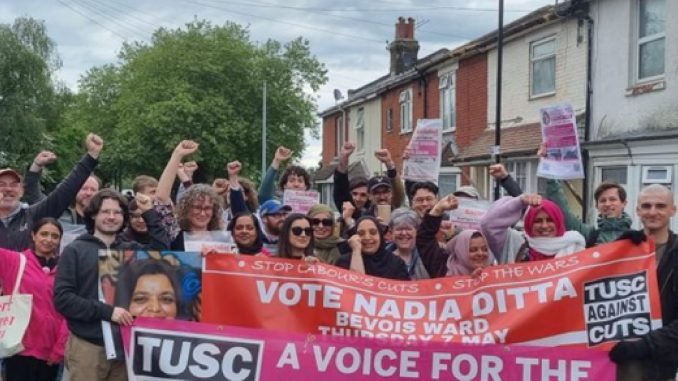
In the Socialist Party we argued that, had it taken a correct approach from the start, Your Party could have made a massive impact on 7 May, winning control of councils with a clear pledge of refusing to implement austerity – either by cutting services or increasing council tax – and demanding that the Labour government restores the funds cut from local government since 2010. The ‘targeted seats’ approach instead adopted, which meant standing only a handful of candidates, and backing some of the hundreds of left independents who stood in this election, could only ever have a tiny impact in comparison. That is why the Socialist Party supported the proposal of the Trade Unionist and Socialist Coalition (TUSC) – an electoral coalition that enables any workers who want to contest elections on a clear anti-austerity basis to do so – to offer the TUSC electoral descriptions to all those in Your Party, and outside, who wanted to see a clear socialist national anti-austerity stand in the election. Had that been taken up, it would have been possible to reach the 840 candidates threshold needed to get ‘fair media’ coverage and an official election broadcast, which could have been used by Jeremy Corbyn and Zarah Sultana.
Unfortunately, that did not happen. Nonetheless, TUSC succeeded in getting around 300 candidates on the ballot paper, making it the sixth biggest party in terms of number of seats. However, inevitably – without the authoritative socialist challenge on national basis which Jeremy Corbyn and Zarah Sultana could have headed up – TUSC candidates, along with many of the patchwork of left independents that stood, were electorally squeezed in these elections (a full analysis of left results in these elections will be available at tusc.org.uk).
There were partial exceptions to this in some areas. These were mainly those candidates, whether independents or representatives of local parties, that stood in areas with a large population from a Muslim background. This is a continuation of the same process which took place in the general election, when four ‘Gaza independent’ MPs were elected. It shows that a majority of Muslim workers remain profoundly hostile Labour as a result of its support for the Israeli state’s genocide in Gaza, as well as austerity and racism in Britain, and are looking to the left which they see defending Palestine – including the record on that issue of prominent left figures like Jeremy Corbyn and George Galloway. This is a positive beginning but, in order to successfully fight for change, a mass party that unites all sections of the working class is needed. The wrong approach of Your Party meant that steps towards that were not taken in this election.
Instead, in England, and to a lesser extent in Wales and Scotland, it was the Green Party under the leadership of Zack Polanski that stepped into the vacuum that Your Party failed to even partially fill. The national profile of the Greens in this election meant that for most of those looking for a means to vote left, and protest against Labour and Reform, the Greens were the clear choice for all but a small conscious minority. This illustrates how, had Your Party been launched on a sound basis, and then organised a serious, national challenge in these elections, it would have transformed the situation. Zack Polanski was fairly unknown when he was elected Green Party leader by around 20,000 Green Party members. Corbyn launched the idea of a new party with a much higher personal profile, widely seen as a principled socialist, as shown by the 800,000 who signed the declaration for a new party. When that potential was squandered 200,000+ surged to instead join the Greens under Polanski. Most importantly, however, the support for the Greens shows the enthusiasm for a left alternative that remains and is growing, despite the many failures of the trade union leaders and others to take the steps needed to build a new workers’ party.
So, should the trade unions just back the Greens?
During this election campaign, on May Day, Zack Polanski declared that ‘the Greens are the workers’ party’ and launched a workers’ charter which included a pledge to introduce a £15 an hour minimum wage and to scrap all anti-union laws introduced since Thatcher came to power in 1979. These pledges will be welcomed by trade unionists, and in the debates in the workers’ movement on political representation, clearly some will argue that the Greens are the solution to the problem.
However, the Greens are about to be tested in power – albeit at local level – to an extent they have not been before. True, even before these elections, existing Green councillors could have been an important weapon in the fight against local council cuts, but instead in 41 councils they were part of administrations – in coalition variously with Labour, Liberals, ‘Independents’ and Tories – and implemented cuts and council tax rises on the same basis as other councillors. Now, however, they have won a number of councils on a different basis, as part of the ‘green anti-austerity surge’. The voters who have thrust them into power in Waltham Forest, Hackney and elsewhere are expecting a council that refuses to implement any more austerity measures.
Before the election we backed a petition, initiated by the Trade Unionists for a New Party campaign, which called on Zack Polanski to join the struggle against local authority austerity and insist that “no candidate shall appear on the ballot paper on behalf of the Greens who has not made a public commitment to vote against all cuts and closures to council services, jobs, pay and conditions should they be elected as a councillor on May 7th.” Zack Polanski did not do so, and in fact has argued that councils have ‘no choice’ but to implement cuts as result of central government austerity. The inevitable result of sticking to that position would be for Green councils to find themselves – no doubt reluctantly – attacking the rights and conditions of local authority workers, and facing strikes against them as a result. The general secretary of Unison was absolutely right when she declare that “Unison will not tolerate attacks on our members from Reform-run local councils. If Reform comes for our jobs, pensions, pay or conditions they will face the full force of the union.” But union members will not accept such attacks whichever party implements them.
However, the question of what role the Greens play in the fight against local authority austerity is not settled. A number of Green candidates did sign the Trade Unionists for a New Party petition, and it is clear that among the Greens that have been elected there are some who want to join the fight against local government cuts. There has also been a proposal from the ‘Greens Organise’ grouping for a summit or conference to discuss building the fight against local government austerity involving Green councils and other anti-cuts councils, alongside trade unions. This would be a positive step which trade unions should take part in, arguing forcefully for the conference to the launch pad for a group of councils to commit not to implement cuts and to take the fight to the government.
What is a workers’ party?
Trade unions approach to the Greens cannot, however, be limited to the questions of local government. Being able to claim to be a workers’ party does not just mean accepting large trade union donations. On that basis the Democrats in the US, or Starmer’s Labour in Britain, would be classified as such! But actually, powerless as the unions are within Labour in Britain, they still have more formal say over decisions than they would if they affiliated to the Green Party at the moment, where they would have no rights at all under its current structure. A democratic structure, within which trade unions have real say in decision making, and elected representatives can be held to account, are vital to the development of a workers’ party. So too, is seeing the working class as the force that is central to change and recognising that the change that is needed is socialism. Debating these issues in the trade union movement in the coming months is going to be vital, as part of the struggle for the working class to develop its own party, not least by the trade unions entering the electoral struggle directly themselves.
Only the beginning
Seismic as these elections were, they are only the beginning of a new period of instability and turmoil in Britain. At this stage Starmer is still in Number Ten, and is insistent that he will not leave. Old time New Labourites Gordon Brown and Harriet Harman have been dragged into to try and shore his leadership up. The fact he is clinging on is not only about his own personal ambition. Above all it reflects the capitalists fear of what could follow him if he goes. On Friday the cost of Britain’s government debt fell slightly, as the hopes of the bond markets grew that Starmer would stay put, rather than be replaced by someone who might be more susceptible to the pressure of the working class. The Financial Times, one of the main mouthpieces for British capitalism, had an article on the issue which quoted ‘fund managers’ relieved that “the Green Party wave” was not “big enough to drag Labour to the left and imperil Starmer”. No surprise that the results of the racists of Reform did not cause the bond markets qualms!
What the unnamed ‘fund managers’ really revealed, however, is the capitalists’ consuming fear of any outlet for working class anger, and the threat they know will come to their rule that when that anger finds a cohesive expression. The shattering of the parties of the capitalist establishment in this May’s elections was only a beginning of that process. Huge class battles are ahead and right now Keir Starmer’s prime ministership is the best political weapon the capitalists have to defend their interests. Nothing could epitomise their weakness more!