deutsch |  english |  español  |  français  |  italiano  |  nederlands  |  polski  |  português  |  svenska  |  türkçe  |  中文  |  عربي  |  русский

latest news

30 years ago
Liverpool - a city that dared to fight

24/05/2013: Interview on Militant, the Labour Party and the struggle of the socialist led council 1983-87 in Liverpool

  Britain, History

Britain
Tories in turmoil over Europe

24/05/2013: The Tories are thrashing around in ever-deeper water on the issue of Europe.

  Britain, Europe

 Kazakhstan
Campaign leader sentenced to ten days in prison

23/05/2013: MEP demands immediate release of Housing Campaigners - solidarity still needed

  Kazakhstan, Solidarity

Britain
No to terrorism! No to racism! No to war!

23/05/2013: Statement on Woolwich killing

  Britain

 Tunisia
the Ministry of Women excuses violations against women rights

23/05/2013: In the «most developped country for women in the Arab world», the struggle for women rights remains more relevant than ever

  Tunisia, Women

Germany
DIE LINKE and the Euro

23/05/2013: After Lafontaine’s proposal to get rid of the Euro – what should the left say?

  Germany, New workers' parties

 Ireland
Tax haven for multinational corporations

22/05/2013: How Ireland is used as a tax haven by multinational corporations while the government is preparing to steal the property tax from people’s wages, social welfare and pensions

  Ireland Republic, Video

Germany
Strike at Amazon

22/05/2013: Union-agreed rates could bring Amazon workers 9000 euros more a year

  Germany

Taiwan
Sea shooting sees Filipino migrants become target of racist backlash

21/05/2013: Anti-racist campaign needed against corrupt ruling elites and capitalism

  Taiwan

Nigeria
President Jonathan declares state of emergency

21/05/2013: An expressway to attacks on democratic rights! For democratic mass working peoples’ defence committees!

  Nigeria

G8 Summit, Northern Ireland
’Why YOU should oppose the G8’

20/05/2013: This year’s G8 summit will be held in County Fermanagh, Northern Ireland, on 17th – 18th June. This gathering brings together the heads of government of eight of the world’s largest capitalist economies to discuss how they can further the interests of those they represent – the super-rich, big business and the bankers.

  Anti-globalisation, Ireland North

World economy
"Central banks are flying blind"

19/05/2013: Increasing concerns and contradictions

  World Economy

South Africa
Mass retrenchment threat in mining industry demands mass action

18/05/2013: Workers and Socialist Party calls for one-day-general strike

  South Africa

Iran
What would a Rafsanjani presidency mean?

18/05/2013: Iran’s June 14 presidential election takes place against the background of deep divisions in society and the regime.

  Iran

Australia
Labour approves WA’s first uranium mine

17/05/2013: Australia’s federal environment minister Tony Burke gave the go ahead to Toro’s $270 million uranium mining project in the Wiluna region of Western Australia.

  Australia, Environment

New Zealand
Racism and recession in New Zealand

15/05/2013: Working class unity needed to defend rights and living standards

  New Zealand

Australian budget
Say ‘NO’ to the cuts agenda of the major parties

14/05/2013: We shouldn’t let either of the major parties tell us that ‘tough decisions’ or ‘hard cuts’ are required.

  Australia

Ireland
‘Bus Eireann workers in front line of class war - We should all support them!’

13/05/2013: Bus workers take strike action over savage wage cuts and attacks on conditions

  Ireland Republic

Italy
The economic crisis becomes a political and institutional crisis

11/05/2013: The latest events that have happened in Italian politics mark a new phase of development in the crisis in the third European industrial power.

  Italy

Turkey / Kurdistan
PKK announces ceasefire

11/05/2013: On 8 May the PKK has begun to withdraw from Turkey. Millions are hoping now for an end to oppression and for democratic rights.

  Kurdistan, Turkey

Malaysia
Election ’victory’ based on fraud

10/05/2013: Ruling Barisan Nasional’s widespread fraud enrages opposition supporters and young people

  Malaysia

Greece
Challenging the Golden Dawn

10/05/2013: On 2 May the neo-fascist Golden Dawn attempted to distribute food in Syntagma square in Athens to people holding proof of Greek nationality.

  Greece

British county elections
Capitalist parties rejected

10/05/2013: Time for a new mass workers’ party

  Britain

Tunisia
The calm before the storm

09/05/2013: New clashes on the horizon

  Tunisia

Pakistan
General elections held amid political turmoil

08/05/2013: Big landlords, capitalists and influential families are calling the shots

  Pakistan

Sri Lanka
Successful May Day

08/05/2013: The United Socialist Party’s May Day demonstration passed successfully through a number of populous areas of Colombo, ending at Grand Pass Junction.

  May Day, Sri Lanka

Hong Kong
Dockworkers’ strike ends after 40 days

07/05/2013: Union representatives declare a “half success” with a pay rise of 9.8 percent – but important issues are unresolved

  Hong Kong

Britain’s ’precariat’
Fighting for real jobs

06/05/2013: ’Get a job!’ is the constant refrain of privileged Tory ministers and vicious right-wing tabloids. A million unemployed young people are the subject of a relentless campaign of smears and lies.

  Britain, Youth

Liverpool
Rally marks 30 year anniversary of election of socialist council

05/05/2013: Great event remembers the ’47’ struggle

  Britain, History

 Women and the struggle for socialism
It doesn’t have to be like this

05/05/2013: Christine Thomas’ book outlines how inequalities and discrimination against women have not disappeared and women’s struggles must be bound up with wider class struggle to be successful. Read the complete book online here.

  Women

Australian budget
Say ‘NO’ to the cuts agenda of the major parties

04/05/2013: Those who created the crisis should be forced to pay.

  Australia

 Nigerian May Day arrests
All DSM members released [updated]
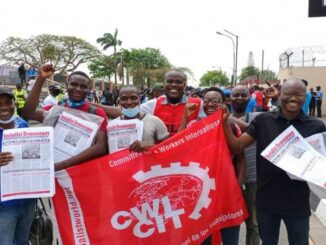
03/05/2013: The last set of DSM members still in the detention of the state security service (SSS) in Kaduna, Northwest Nigeria, and Ibadan Oyo state, Southwest Nigeria, as of yesterday, has been released.

  May Day, Nigeria, Solidarity

Turkey

Brutal reality behind the West’s much-praised AKP government model

www.socialistworld.net, 30/03/2012
website of the committee for a workers' international, CWI

Turkey’s governing ’Justice and Development Party’ (AKP) is presented as a model of “successful democracy” by US Secretary of State Hillary Clinton. In fact, it is a brutal model of repression against Kurdish and left activists and is presented as way of dealing with the democratic aspirations of the Arab and North African spring.

Kai Stein, CWI

On Sunday, 18 March, police brutally attacked Kurdish rallies, arrested 100 people. In Istanbul, a district official from the Peace and Democracy Party (BDP), the main Kurdish party in Turkey, was killed after he was struck on the head by a police tear gas canister.

Kurds all over Turkey were celebrating Newroz, their New Year festival. Traditionally, it is much more than a celebration: it is a mass gathering, like a demonstration, with many dancing and marching for Kurdish rights. As part of the increased repression against Kurdish people over the last year, police tried to suppress celebrations on Sunday. However, 40,000 rallied in Diyarbakir. Tens of thousands came together in different cities.

This shows that protests are continuing despite increasing state pressure. Following accusations against people of belonging or supporting the Kurdistan Communities Union (KCK), an alleged political offshoot of the outlawed Kurdistan Workers Party (PKK), the number of people arrested has risen dramatically in recent years from 16,000 in 2005 to more than 60,000 in 2010. In 2005, 17 children were jailed but 1,023 children were imprisoned in 2010, most of them accused of throwing stones against police and taking part in illegal demonstrations. In March 2012, Raci Bilici, the acting chairman of the south-eastern chapter of Turkey’s Human Rights Association reported: “The number of detentions doubled last year, and torture and sexual harassment of prisoners is on the rise.” [Economist, 24 March.]

“Turkey has the highest number of arrested journalists in the world... The Justice and Development Party (AKP) is abusing the anti-terror law,” a report of Reporters Without Borders’ (RSF) stated in January 2012. It continues: “Under the pretext of combating terrorism, dozens were jailed before being tried, above all in the investigations into the Ergenekon conspiracy and the KCK”.

The Ergenekon allegation was first used against the Kemalist forces, the traditionally secularist wing of the capitalist elite, within the state and military, who tried to defend their positions. Later on, it turned into widespread allegations of coup plots used also against left-wing journalists and many others. Those accused are held in prison without trial, in some cases for many years.

The policy of the AKP, in the direction of a slow but constant Islamisation of society, is a growing problem for women. When the AKP government was first elected in 2002, the immediate fears of attacks on women did not fully materialise. However, there is an ongoing deterioration of the situation. Domestic violence is rising and the number of ‘honour killings’ is increasing. “Though it is ranked the 16th largest economy in the world... Turkey ranks 122 out of 135 countries when it comes to male-female disparity,” the Turkish paper Hürriyet reported.

Despite all that, US Secretary of State Hillary Clinton praised “Turkey’s successful democracy” as a source of “very strong support” for the countries of the region and a “real example” for them (Financial Times, 26 February 2012). On behalf of US imperialism, Clinton has no problems with thousands of BDP activists, including eight elected members of the national parliament and mayors, being imprisoned.

Change of course by Erdoğan’s AKP government

Up to the Turkish elections in June 2011, the AKP presented itself as moderate and democratic. Even Kurdish rights improved in some ways. For example, the Kurdish language was allowed to be heard on some radio programmes (although only speaking censored words).

Kurdish people hoped that Prime Minster Recep Erdoğan would announce a further ‘Kurdish Opening’. But even before the 2011 elections, the AKP government were preparing a new escalation of the war against the PKK with the creation of special forces. This escalation became much more widespread than expected by any commentator. After the elections, Erdoğan’s government escalated the war against the PKK and the repression against Kurdish people. (See article: “Turkey / Kurdistan: Erdoğan escalates attacks on PKK”)

The relative quiet of industrial disputes aided Erdoğan. The workers’ movement did not continue its significant steps forward in 2009 and 2010, when the Tekel workers fought privatisation and hundreds of thousands of workers flooded Taksim Square and many other places on 1 May, for the first time in many years. Smaller battles followed, but the relative stability of the Turkish economy helped to avoid bigger conflicts with workers.

The economy is still based on the huge influx of foreign investment linked to a deficit in the trade balance. Given the instabilities and prospects of international, especially European, economic turmoil, Turkey’s economy is highly vulnerable. A ten per cent current-account gap is a huge burden on the prospects for growth and the gap expanded faster than expected in March with rising oil prices. The backing Erdoğan received because of these economic developments does not have a solid base.

However, strengthened by the elections in June 2011 and empowered by the new role of Turkey in the region, Erdoğan felt strong enough to throw a final blow at the Kemalist elites. This went hand in hand with the use of more police state measures against Kurdish and Left activists and the escalation of the military war against the PKK.

Those forces on the Left who made big gains in and around the election times were targeted. The BDP, the main Kurdish party with big influence of the PKK, formed a ‘Work, Democracy and Freedom Bloc’ for the 2011 elections, giving three socialists the chance to enter parliament. Erdoğan hopes to counter the strengthening of the Kurdish and Left forces with police brutality.

“Zero problems” with dictators, a lot of problems with the Arab and North African Spring

The changes in the region are seen by many commentators as a political and economic chance for Turkey. However, first of all, this was a setback.

Since the AKP came to power, it has followed the objective of reducing conflicts with its neighbours, in an attempt to increase trade. This worked well with Syria, for example. It helped to position Turkey between Europe and the Middle East, including the Arab world. This increased the chances of Turkey playing more of a role as a regional power, competing with Egypt, Iran and others.

The AKP announced, once in power, its “zero problem with the neighbours” strategy. In practice, this meant there was no problem dealing with all the dictators and authoritarian regimes in the region and no problem dealing with Israel.

This strategy failed when confronted with the revolutionary movements in North Africa and the Middle East.

The Turkish regime tried to stick to its good relations with Qaddafi in Libya. It was the last NATO member to support the rebels. Turkish capitalists found themselves in an uncomfortable situation after the war.

Trying to learn some lessons from that, the Turkish regime followed the opposite route with Syria: it criticised Assad, demanding ‘democratic reforms’ and imposing sanctions. But this just openly marked the end of the “zero problems” policies, a collapse of trade with Syria and – instead of growing economic inter-relations – the destabilisation of the region flowing from the conflict within Syria.

The new regimes in Egypt and Tunisia were welcomed by Erdoğan and he visited these countries. However, the economy in Egypt is in a poor state and the aspirations of the Egyptian regime, as a regional power, are increasing. The whole regional policy of Turkey has to be re-developed.

A possible breakup of Iraq, with Kurdish people getting more autonomy or even their own ‘state’, a fragmentation of Syria and increased Kurdish resistance in Iran against the regime could all encourage the Kurdish people in Turkey to continue their fight against oppression.

Under the pressure of the Turkish people’s sympathy with the oppressed Palestinians, the Ankara regime tried to use anti-Israeli moods, while, at the same time, expanding its military co-operation and trade with Israel. These links are now stretched however and the tensions between the former allies are sharper than at any time in the last period.

Why is this regime called a ‘model’?

After decades of big conflicts between the Turkish state and the workers’ movement, with military coups at least every ten years, an ongoing war with Kurdish people, an economic meltdown in 2000-01 and the destruction of most the main Turkish political parties, Turkey arose in the last decade like a phoenix from ashes. Stable conditions for foreign investment, growth rates at the same scale as China and a low level of strikes in the first years of AKP rule meant that Turkey unexpectedly became a something of a paradise for international capitalists.

The AKP was formed from splits amongst the previously outlawed Islamist forces. Its support is rooted in religious sentiments. Its basis traditionally came from the middle classes in the more backward, rural areas of eastern Turkey. Not challenged by any serious mass party of the working class, it was able to present itself as the alternative to all the rotten, corrupt parties of the elites.

After Turkey’s devastating economic crisis in 2000-01, space opened for some recovery, given the background of the international upswing until 2007. International capital, in search of profitable investments, located the ruined Turkish markets and seized the opportunity. An unprecedented boom followed in Turkey and gave Erdoğan some credibility. As the banking sector in Turkey had already collapsed eight years earlier, the crisis of 2007-08 did not hit the country particularly hard.

International capitalist commentators concluded that a moderate Islamist party, like the AKP, might be a stable force to organise a framework for international investment. It might use religion in the region to build support for neo-liberal policies which otherwise would meet harsh resistance.

This confuses cause with effect: the relatively stable economic conditions allowed the AKP to play this role over ten years. The increasing brutality of its regime shows the sharp limitations of Erdoğan’s rule. The oppression used against Kurdish people, the Left and some parts of the former elite, only stores up future explosions. Whether this will take the form of further nationalist or religious tensions, or if the workers’ movement is able to channel mass disaffection to positively alter the course of developments, depends on whether the workers’ movement is re-built. This requires building a new mass party of working people, armed with a bold socialist programme to change society fundamentally.

In this process, a strong Marxist force is needed, bringing together activists from workplaces, trade unions and social movements, as well as Kurdish rights activists. Today, many on the left are attracted to the idea of an election block around the BDP and some smaller left forces that calls for “work, democracy and freedom”. But they will find that the leaderships of these parties will offer much less than they need. Any new umbrella party formed around this block – which is being discussed at the moment – needs a programme that calls for the reversal of the huge privatisations of the AKP government, the nationalisation the big banks and corporations, under workers’ control and management, the rebuilding and planning of the economy, to met the needs of people and not the short term interests of profit-greedy international capital. It needs to link the struggle for democratic rights – workers’ rights, an end to all forms of discrimination and the oppression of Kurdish and Armenian people and women – to the fight against capitalism and imperialism.

The Kemalist forces and their political party, the CHP, are not offering any fundamental alternative. The trap of supporting one “progressive” wing of the capitalists against other wings, dropping socialist demands in order not to ‘repel’ these forces, has wrecked the Left in Turkey all too often. A working class independent class policy is the only way to show a path out of capitalist exploitation and oppression.

Copycat effects

In Egypt’s 2011 elections, the biggest and most moderate part of the Muslim Brotherhood called itself the ‘Freedom and Justice Party’, with a nod to the AKP. In Morocco, a party, directly named after the AKP, ‘Justice and Development Party’, won elections in November 2011. In Tunisia, the now governing Ennahda party says its model is the Turkish AKP. In Libya, the newly formed National Gathering for Freedom, Justice and Development, is expected to win broader support.

All these forces are trying to exploit the support of Turkey’s AKP. They combine milder versions of Islamist beliefs, for example rejecting the implementation of Sharia law, with neo-liberal measures and economic policies.

Looking back at the model in Turkey itself, these attempts, and the advice of people like Clinton to follow the AKP example, are not only cynical and against the interests of workers and the poor fighting for democracy and better living conditions, they also represent the empty hope of the imperialist powers that this model can guarantee stability and profits. The economic crisis is looming over Europe, the Middle East and Northern Africa. The fuel to push the revolutionary processes further is still there. Turkey is more likely to move in the direction of Egypt or Tunisia than the other way round.


Europe

 video

Ireland: Tax haven for multinational corporations, 22/05/2013

 further videos

CWI - get involved


solidarity

tamil solidarity campaign kazakhstan

featured links

Paul Murphy, MEP

cwi links

Marxist.net, CWI marxist archive

cwi comment & analysis

world economic crisis

analysis and commentary


cwi publications

marxism in today's world che

Che Guevara: Símbolo de Lucha

Por Tony Saunois

A socialist world is possible, the history of the cwi with new introduction by Peter Planning green growth, a contribution to the debate on enviromental sustainability

NEWS

30 years ago: Liverpool - a city that dared to fight
24/05/2013, Peter Taaffe speaking to "Tony Snell in the Morning", BBC Radio Merseyside:
Interview on Militant, the Labour Party and the struggle of the socialist led council 1983-87 in Liverpool

Britain: Tories in turmoil over Europe
24/05/2013, Editorial of the Socialist, paper of the Socialist Party (CWI England & Wales):
The Tories are thrashing around in ever-deeper water on the issue of Europe.

Kazakhstan: Campaign leader sentenced to ten days in prison
23/05/2013, Campaign Kazakhstan:
MEP demands immediate release of Housing Campaigners - solidarity still needed

Britain: No to terrorism! No to racism! No to war!
23/05/2013, Greenwich Socialist Party (CWI England & Wales), London:
Statement on Woolwich killing

Tunisia: the Ministry of Women excuses violations against women rights
23/05/2013, Aïda, CWI member in Tunisia:
In the «most developped country for women in the Arab world», the struggle for women rights remains more relevant than ever

Germany: DIE LINKE and the Euro
23/05/2013, Sascha Stanicic and Lucy Redler, SAV (CWI Germany):
After Lafontaine’s proposal to get rid of the Euro – what should the left say?

Ireland: Tax haven for multinational corporations
22/05/2013, Paul Murphy, MEP, Socialist Party (CWI Ireland):
How Ireland is used as a tax haven by multinational corporations while the government is preparing to steal the property tax from people’s wages, social welfare and pensions

Germany: Strike at Amazon
22/05/2013, An Amazon activist reporting to SAV (CWI Germany):
Union-agreed rates could bring Amazon workers 9000 euros more a year

Taiwan: Sea shooting sees Filipino migrants become target of racist backlash
21/05/2013, Chris Dite and CWI Taiwan reporters, article from Chinaworker.info:
Anti-racist campaign needed against corrupt ruling elites and capitalism

G8 Summit, Northern Ireland:’Why YOU should oppose the G8’
20/05/2013, Socialist Party, Northern Ireland (CWI Ireland):
This year’s G8 summit will be held in County Fermanagh, Northern Ireland, on 17th – 18th June. This gathering brings together the heads of government of eight of the world’s largest capitalist economies to discuss how they can further the interests of those they represent – the super-rich, big business and the bankers.

South Africa: Mass retrenchment threat in mining industry demands mass action
18/05/2013, DSM (CWI South Africa) reporters:
Workers and Socialist Party calls for one-day-general strike

Iran: What would a Rafsanjani presidency mean?
18/05/2013, Kave Heydari, Iranian CWI supporter in Britain:
Iran’s June 14 presidential election takes place against the background of deep divisions in society and the regime.

Australia: Labour approves WA’s first uranium mine
17/05/2013, Socialist Party (CWI Australia) reporters Perth:
Australia’s federal environment minister Tony Burke gave the go ahead to Toro’s $270 million uranium mining project in the Wiluna region of Western Australia.

New Zealand: Racism and recession in New Zealand
15/05/2013, Jared Phillips, CWI New Zealand:
Working class unity needed to defend rights and living standards

Australian budget: Say ‘NO’ to the cuts agenda of the major parties
14/05/2013, Editorial comment from ‘The Socialist’, paper of the Socialist Party (CWI Australia):
We shouldn’t let either of the major parties tell us that ‘tough decisions’ or ‘hard cuts’ are required.

Ireland: ‘Bus Eireann workers in front line of class war - We should all support them!’
13/05/2013, Socialist Party (CWI Ireland) Reporters:
Bus workers take strike action over savage wage cuts and attacks on conditions

May Day in Nigeria: Jonathan government intensifies attacks on democratic rights
12/05/2013, Ebike Iseru, DSM (CWI Nigeria):
15 DSM members arrested at May Day rallies

Italy: The economic crisis becomes a political and institutional crisis
11/05/2013, Marco Veruggio, ControCorrente (CWI Italy):
The latest events that have happened in Italian politics mark a new phase of development in the crisis in the third European industrial power.

Malaysia: Election ’victory’ based on fraud
10/05/2013, Ravichandren, CWI Malaysia:
Ruling Barisan Nasional’s widespread fraud enrages opposition supporters and young people

Greece: Challenging the Golden Dawn
10/05/2013, Katerina Kleitsa , Xekinima (CWI Greece):
On 2 May the neo-fascist Golden Dawn attempted to distribute food in Syntagma square in Athens to people holding proof of Greek nationality.

British county elections: Capitalist parties rejected
10/05/2013, Editorial of the Socialist, paper of the Socialist Party (CWI England & Wales):
Time for a new mass workers’ party

Tunisia: The calm before the storm
09/05/2013, CWI reporter in Tunis:
New clashes on the horizon

Pakistan: General elections held amid political turmoil
08/05/2013, Khalid Bhatti, SMP (CWI Pakistan), Lahore:
Big landlords, capitalists and influential families are calling the shots

Sri Lanka: Successful May Day
08/05/2013, USP(CWI, Sri Lanka):
The United Socialist Party’s May Day demonstration passed successfully through a number of populous areas of Colombo, ending at Grand Pass Junction.

Hong Kong: Dockworkers’ strike ends after 40 days
07/05/2013, Vincent Kolo, chinaworker.info:
Union representatives declare a “half success” with a pay rise of 9.8 percent – but important issues are unresolved

CWI Comment and Analysis

ANALYSIS

Nigeria: President Jonathan declares state of emergency
21/05/2013, Segun Sango, Protem National Chairperson, Socialist Party of Nigeria:
An expressway to attacks on democratic rights! For democratic mass working peoples’ defence committees!

World economy: "Central banks are flying blind"
19/05/2013, Per-Åke Westerlund, from Offensiv, newspaper of Rättvisepartiet Socialisterna (CWI Sweden):
Increasing concerns and contradictions

Turkey / Kurdistan: PKK announces ceasefire
11/05/2013, Festus Okay, Sosyalist Alternatif (CWI Turkey):
On 8 May the PKK has begun to withdraw from Turkey. Millions are hoping now for an end to oppression and for democratic rights.

Women and the struggle for socialism: It doesn’t have to be like this
05/05/2013, Christine Thomas, Controcorrente (CWI Italy):
Christine Thomas’ book outlines how inequalities and discrimination against women have not disappeared and women’s struggles must be bound up with wider class struggle to be successful. Read the complete book online here.

Cyprus: On the edge of a catastrophic slump
25/04/2013, Niall Mulholland, CWI:
Socialist polices needed to resolve crisis in the interests of majority

US: After the Boston Tragedy
23/04/2013, Bryan Koulouris, Boston, Socialist Alternative (CWI supporters in the US):
NO to Racism and Repression

Britain: Combating violence against women
14/04/2013, Hannah Sell, on behalf of the Socialist Party (CWI England & Wales) Executive Committee:
A socialist perspective on fighting women’s oppression

Thatcher: A class warrior for capitalism
12/04/2013, Alistair Tice, Socialist Party regional secretary, Yorkshire:
Millions have been waiting for this day, 8 April 2013. Margaret Thatcher will never be forgiven for the devastation that her Tory governments’ policies wrought on working class communities in the 1980s - and is still being felt today.

Britain: Margaret Thatcher dies
08/04/2013, Peter Taaffe, Socialist Party (CWI England & Wales) general secretary:
Thatcher’s bitter legacy

Britain: A further round of savage austerity
08/04/2013, Peter Taaffe, Socialist Party (CWI England & Wales) general secretary:
We must stop them!

Israel: “There is a future” – of cuts, racism and resistance
05/04/2013, Socialist Struggle Movement (CWI Israel/Palestine):
Weak Israeli government will try to implement austerity budget, and would try to maintain the occupation, possibly under a new cover of "negotiations" with Palestinians. Resistance likely on all fronts.

Cyprus: “Working people pay high price for crisis of euro and capitalism”
31/03/2013, Niall Mulholland spoke with Athina Kariati from New Internationalist Left (CWI in Cyprus) about Cyprus’s deal with the Troika, what it will mean for working people and what is the socialist solution to the crisis:
Interview with a Cypriot socialist

China: New leadership rejects democratisation
28/03/2013, Vincent Kolo, chinaworker.info:
At annual NPC-CPPCC meetings Xi Jinping and Li Keqiang talk of ‘tough reforms’ for economy, but rule out ‘Western models’

Venezuela: After the death of Hugo Chávez
24/03/2013, Tony Saunois, CWI, a shorter version of this article was first published in Socialism Today, magazine of the Socialist Party (CWI England & Wales:
Radical, populist policies and anti-imperialism helped transform the political situation

Italy’s clowns: No joke for establishment parties
23/03/2013, Christine Thomas, ControCorrente (CWI in Italy), first published in Socialism Today, magazine of the Socialist Party (CWI England & Wales):
In his ‘tsunami’ election tour Grillo began to give voice to the deep discontent at economic crisis and austerity

Cyprus/EU: Eurozone back in turmoil
22/03/2013, Tony Saunois, CWI:
No trust in capitalist government! No austerity for the Euro! Kick out the Troika! For a socialist alternative!
[Updated article, 25 March]

South Africa: Workers & Socialist Party launched in Pretoria
21/03/2013, CWI reporters, South Africa:
Launch surpassed all expectations

Iraq: Ten years since ‘shock and awe’
20/03/2013, Niall Mulholland, from The Socialist, weekly newspaper of the Socialist Party (CWI England and Wales):
Imperialism’s harvest of death and destruction

March 8th: The day of international working women’s solidarity
07/03/2013, Clare Doyle, CWI:
Beware the anger of women against the bosses’ system!

Hugo Chavez dies: The struggle continues
06/03/2013, Tony Saunois, CWI Secretary:
Millions of Venezuelan workers, the poor and youth will mourn the death of Venezuelan president, Hugo Chavez

Lebanon: Public sector workers on indefinite strike over wages
04/03/2013, Tamer Mahdi, CWI:
Workers’ unity against big business shows potential for anti-sectarian, socialist alternative

Portugal: New explosion against austerity and the government
03/03/2013, socialistworld.net:
“Screw the Troika – the people are the best rulers”

Tunisia: ‘Buckshot’ Ali Larayedh appointed prime minister
27/02/2013, CWI supporters in Tunisia:
Down with the Ennahdha regime! Down with the system!

Italy: Voters reject austerity in ‘tsunami’ election
27/02/2013, Chris Thomas, Controcorrente (CWI in Italy):
Political instability, crisis and new opportunities ahead